

Table of Contents
- What Small-Batch Roasting Actually Means
- Precision Roasting and Flavor Control
- Small Batch vs. Commercial Coffee Roasting
- Freshness and the Impact of Roast Date on Flavor
- How to Store Fresh Roasted Coffee for Maximum Quality
- Consistency, Quality Assurance, and Customized Roast Profiles
- Sustainability and the Environmental Advantage
- Conclusion
- Frequently Asked Questions
Last Updated: September 23, 2026
What Small-Batch Roasting Actually Means
Small batch roasting refers to the practice of roasting coffee beans in smaller quantities, typically between 5 and 50 pounds per roast, compared to the hundreds or thousands of pounds processed by commercial operations. This approach prioritizes precision over volume, allowing roastmasters to maintain tighter control over every variable that shapes the final cup. At Righteous Roast, we focus on this method because it's the foundation for everything that follows: exceptional flavor and genuine freshness.
The difference between small-batch and industrial roasting isn't just about scale. When you roast smaller quantities, thermal responsiveness improves dramatically. The roaster responds faster to heat adjustments, which means you can follow a more precise roasting curve and catch the exact moment when the Maillard reaction reaches its peak for that particular bean. This level of feedback and control is nearly impossible at commercial scale, where roasters must process volume consistently and quickly.
The Chemistry Behind Small-Batch Precision: The Maillard Reaction
Understanding why small-batch roasting excels requires understanding the Maillard reaction, the chemical process that creates coffee's flavor and color. The Maillard reaction begins around 300°F and accelerates rapidly as temperature increases. It's a complex cascade where amino acids and reducing sugars interact under heat to form hundreds of new flavor compounds, browning pigments, and aromatic molecules. This reaction doesn't happen uniformly; it progresses at different rates depending on bean moisture content, bean density, ambient temperature, and heat application speed.
Small-batch roasters can optimize this reaction because they can monitor and adjust conditions in real time. In a 10-pound batch, heat distributes more evenly than in a 500-pound drum. The roastmaster hears the first crack (the moment cell walls rupture and release CO₂, marking the start of the second phase of roasting) more distinctly and can adjust airflow and heat immediately. This precision matters because the Maillard reaction accelerates exponentially in the final minutes of roasting. A 30-second difference in roast time can shift flavor from bright and complex to flat or bitter. Commercial roasters, constrained by batch size and standardized curves, cannot make these micro-adjustments without disrupting production.
Small-batch roasters also benefit from better heat transfer uniformity. Smaller batches mean shorter distances for heat to travel through the bean mass, reducing the variance between the hottest and coolest beans in the roast. This uniformity ensures that the Maillard reaction progresses at similar rates across all beans, producing consistent flavor development rather than a mix of under- and over-roasted beans in the same batch.
Small-batch roasting also changes the economics of freshness. Because less coffee is roasted at once, inventory turns faster. Beans spend less time in storage before reaching your hands, which matters more than most people realize.
Precision Roasting and Flavor Control
Precision roasting is where small-batch methods show their real advantage: the ability to develop specific flavor notes and achieve consistency that larger operations struggle to match. When you roast in smaller batches, heat transfer becomes predictable. The beans heat evenly, the roasting curve stays stable, and the roastmaster can make real-time adjustments based on what they hear, smell, and observe.
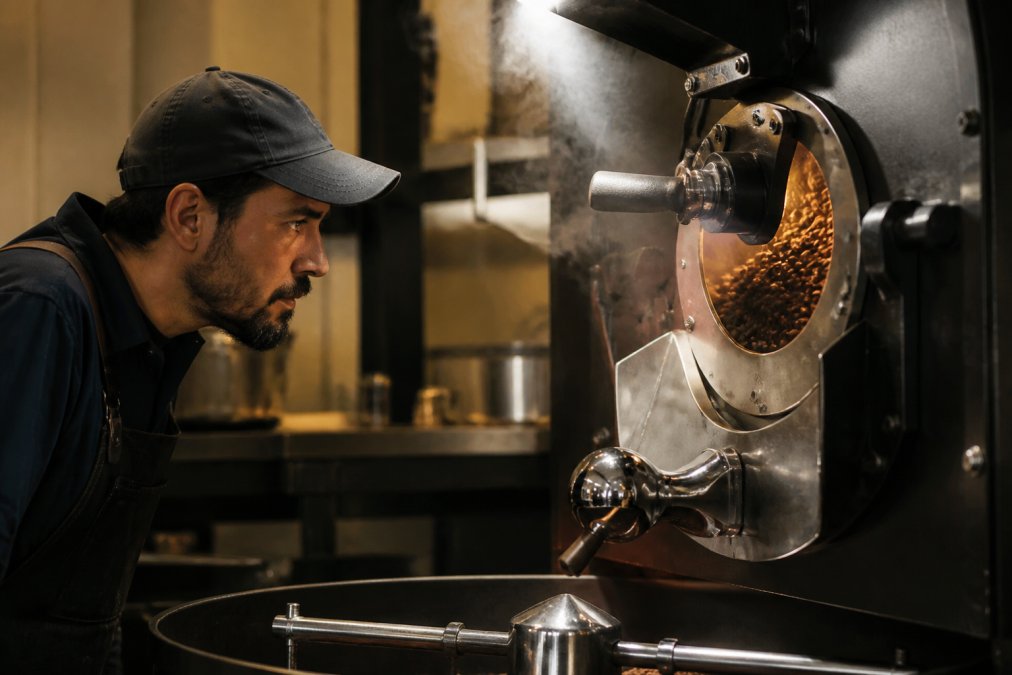
Each roast profile is essentially a recipe. A roastmaster decides when to apply heat, how fast to increase temperature, when to introduce air flow, and most critically, when to stop the roast. That final decision determines whether you get bright, complex flavor notes or deeper, more chocolatey ones. Small batches allow this decision to be made with precision because the roaster can hear the first crack of the beans, monitor color development closely, and pull the batch at exactly the right moment.
This precision directly translates to flavor clarity. Beans roasted in small batches tend to express their origin characteristics more distinctly. A single-origin Ethiopian might show floral and citrus notes that would get buried in a commercial roast where consistency takes priority over nuance. The thermal responsiveness of small-batch equipment means the roastmaster isn't fighting against the machine's momentum; they're working with it.
Small Batch vs. Commercial Coffee Roasting
The comparison between small-batch and commercial roasting reveals fundamental trade-offs. Commercial roasters prioritize consistency and volume. They're engineered to process hundreds of pounds per hour with minimal variation from batch to batch. This is valuable for businesses that need reliable supply and predictable costs. However, that consistency comes at the cost of flexibility.
A commercial roaster can't easily pivot to a new roast profile for a single-origin bean that just arrived. The machine is optimized for a standard curve that works across many different beans. Small adjustments take time and disrupt production. The roastmaster has less real-time control because the scale of the operation demands standardized processes.
Small-batch roasting flips this equation. Flexibility and customization become possible because the stakes of changing course are lower. A roastmaster can roast a test batch of a new bean origin, evaluate the results through cupping, adjust the profile, and roast again within hours. This iterative approach to quality assurance is what allows specialty coffee producers to offer truly distinctive products.
The trade-off is cost. Small-batch roasting requires more labor per pound and more equipment investment relative to volume. This is why specialty coffee costs more than commercial alternatives. You're paying for precision, freshness, and the roastmaster's expertise, not just beans.
Instant Coffee — Specialty Grade →
Freshness and the Impact of Roast Date on Flavor
Freshness is where small-batch roasting delivers its most immediate, tangible benefit. Coffee flavor degrades predictably after roasting. The aromatic compounds that define a coffee's taste begin to oxidize and escape from the moment the beans cool. This process accelerates over weeks and months.
A roast date that's only a few days old tastes noticeably different from one that's three weeks old. The difference isn't subtle. Fresh-roasted coffee has clarity, brightness, and complexity that fades as the beans age. Commercial coffee, which may sit in warehouses or on store shelves for weeks before reaching you, has already lost significant flavor potential by the time you brew it.
Small-batch roasting keeps roast dates fresh because smaller quantities mean faster turnover.
How to Store Fresh Roasted Coffee for Maximum Quality
Once you have fresh-roasted coffee, storage becomes critical. The goal is to slow oxidation and preserve those volatile aromatic compounds as long as possible. Proper storage extends the window during which your coffee tastes its best.
Consistency, Quality Assurance, and Customized Roast Profiles
Consistency in small-batch roasting doesn't mean every batch tastes identical. It means every batch meets a defined standard for that specific roast profile. Quality assurance in specialty coffee relies on cupping, a formal tasting process where roastmasters evaluate beans systematically and compare batches to a reference standard.
Sustainability and the Environmental Advantage
Small-batch roasting offers genuine environmental advantages compared to industrial operations, though the benefits are often misunderstood and rarely quantified. The primary advantage is energy efficiency per unit. Smaller roasters heat up faster, require less total energy to reach roasting temperature, and cool down more quickly. This translates to lower energy consumption per pound of coffee roasted.
Energy Efficiency Metrics
A typical commercial coffee roaster (500+ pounds per batch) consumes approximately 3-5 kilowatt-hours of energy per pound of roasted coffee, depending on the roasting duration and equipment age. Small-batch roasters (10-50 pounds per batch) typically consume 1.5-2.5 kilowatt-hours per pound. The difference stems from several factors: smaller roasters reach operating temperature in 15-20 minutes versus 30-45 minutes for large drums; they require less energy to maintain temperature during roasting because the thermal mass is lower; and they cool faster, reducing the total energy footprint per batch.
Waste Reduction and Supply Chain Sustainability
There's also less waste in small-batch operations. Commercial roasting generates chaff (the papery skin that flakes off beans during roasting), broken beans, and off-spec coffee that must be discarded or repurposed. Small-batch operations can be more selective about bean quality and waste management. Many small roasters compost chaff or donate off-spec beans rather than sending them to landfill. Chaff alone represents 15-20% of the raw bean weight; a small-batch roaster processing 50,000 pounds annually generates 7,500-10,000 pounds of chaff, much of which can be composted or used as biomass fuel rather than landfilled.
Conclusion
Small-batch roasting delivers measurable benefits across flavor, freshness, consistency, and sustainability. The precision that small-batch methods enable creates coffee with clarity and complexity that larger operations can't match. Freshness improves because smaller quantities turn over faster, and proper storage extends that freshness window significantly. The customized roast profiles possible only at small scale allow roastmasters to optimize for specific bean origins and desired flavor outcomes.
Frequently Asked Questions
What exactly defines small-batch roasting, and how is it different from commercial roasting?
Small-batch roasting typically involves roasting smaller quantities of green coffee at one time, allowing roastmasters to monitor thermal responsiveness and heat transfer more closely. Commercial roasting processes larger volumes with automated systems, prioritizing speed and volume over individual batch attention. The key difference: small-batch roasters can adjust roast profiles in real time based on feedback loops, while commercial operations follow preset curves. This precision creates more consistent quality and clearer flavor notes in each batch.
How does the roast date impact the flavor of my coffee?
Coffee flavor peaks within 2-4 weeks after roasting. During this window, the beans release CO2 and develop their full flavor profile. After 4 weeks, flavor clarity begins to fade, and the coffee tastes flat or stale. Small-batch roasting ensures your coffee ships fresh, often roasted within days of order, so you experience peak flavor when it arrives. Buying from roasters who print roast dates on packaging lets you verify freshness and understand exactly how old your beans are.
Is small-batch roasted coffee worth the price difference compared to grocery store coffee?
Yes, for several reasons. Small-batch roasters use specialty-grade beans with careful sourcing and ethical practices, invest in precision roasting equipment, and roast to order for maximum freshness. Grocery store coffee is often roasted weeks or months prior and stored in conditions that accelerate staling. You're paying for superior bean quality, intentional flavor development, and coffee that actually tastes like the origin profile rather than generic 'coffee.' Many customers report using less coffee per cup because small-batch roasted beans are more flavorful.
How should I store small-batch roasted coffee to keep it fresh?
Store whole beans in an airtight container away from light, heat, and moisture, a cool, dark cabinet works best. Avoid the freezer unless storing for 3+ months; condensation damages beans. Use beans within 2-4 weeks of the roast date for peak flavor. Grind immediately before brewing to preserve freshness. If you buy sample sizes, smaller quantities mean you finish them faster, ensuring you experience the intended flavor profile before the beans begin to fade.