

Table of Contents
- Why Coffee Freshness Matters
- Check the Roast Date and Shelf Life After Roasting
- Inspect Beans Visually for Signs of Staleness
- Use the Coffee Bloom Test to Assess Freshness
- How to Store Whole Bean Coffee for Maximum Freshness
- Evaluate Aroma and Taste Profile Changes
- Frequently Asked Questions
Last Updated: September 25, 2026
Why Coffee Freshness Matters
Fresh coffee tastes better and delivers the full complexity of the roast. Stale coffee loses its spark, vibrant notes flatten into a hollow, papery taste.
Quality beans are an investment. Understanding how to tell if coffee is fresh means you'll get the most from every bag. At Righteous Roast, we roast in small batches.
Freshness also affects extraction. Fresh beans release CO2 during the bloom phase, helping water penetrate grounds evenly. Stale beans don't bloom the same way, resulting in weak or bitter coffee.
Check the Roast Date and Shelf Life After Roasting
The roast date is your first checkpoint. It should be clearly printed on the bag. If you can't find it, that's a red flag.
Fresh whole bean coffee is best within two to four weeks after roasting. During the first week or two, beans release CO2 intensely through degassing. By week three or four, degassing slows and the flavor profile stabilizes into what the roaster intended.
After four weeks, oxidation accelerates. Bean oils migrate and break down, causing aroma to fade and taste to become muted.
Here's what to look for:
- Within 2 weeks: Peak freshness. The bloom test will be dramatic. Aroma will be intense.
- 2 to 4 weeks: Still excellent. Flavor is fully developed. Degassing is mostly complete.
- 4 to 8 weeks: Acceptable but noticeably less vibrant. The lively character fades.
- Beyond 8 weeks: Stale. The coffee will taste flat and lack complexity.
Don't rely on expiration dates, they're often printed months after roasting. The roast date is what matters. Reputable roasters always provide this information.
Inspect Beans Visually for Signs of Staleness
Your eyes tell you a lot about freshness. Understanding the chemistry behind visual changes helps you diagnose age with confidence.
The Oil Surface: Your Primary Freshness Indicator
Fresh beans appear slightly oily on the surface, a sign of quality. Those oils contain volatile aromatic compounds and flavor esters that create complex, vibrant taste. CO2 escaping from inside the bean creates pressure that keeps oils outward.
As beans age, oxidation breaks down those oils and the surface becomes dry and matte. CO2 degassing slows after 2-3 weeks, internal pressure drops, and oils no longer migrate outward. Oxygen reacts with oils and flavor compounds, breaking them into stale molecules.
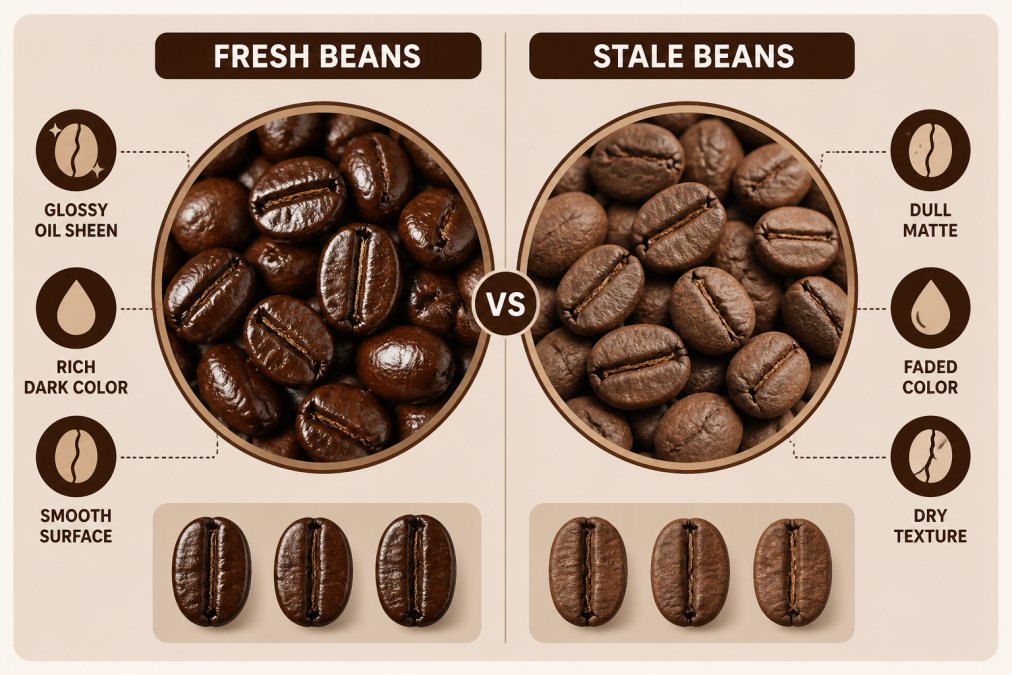
Comparing fresh and stale beans side by side reveals an unmistakable difference: fresh beans look wet and alive; stale beans look dull and papery.
Color and Texture Changes Over Time
Color fading is a reliable age marker. Dark roasts should appear deep black or dark brown with a slight sheen; stale ones turn gray-brown or ashy. Medium roasts should be warm, chocolatey brown; stale ones look pale or washed out.
Texture also changes. Fresh beans have a smooth, uniform surface. As they age, watch for excessive deep cracks (8+ weeks old), uneven coloring (uneven oxidation), or chalky coating (moisture exposure or severe oxidation).
A Diagnostic Checklist
When inspecting a bag, check multiple beans from different parts. Oxidation happens unevenly, so consistency matters.
- Fresh (0-2 weeks post-roast): Glossy surface with visible oils. Rich, deep color. Smooth texture. Consistent appearance across all beans.
- Good (2-4 weeks post-roast): Still oily, though slightly less glossy than peak. Color remains rich. Uniform appearance.
- Declining (4-8 weeks post-roast): Noticeably drier surface. Color fading. Some texture variation between beans.
- Stale (8+ weeks post-roast): Matte, dry surface. Faded color. Visible cracks or chalky coating. High variation in appearance.
Combine visual inspection with the roast date, bloom test, and aroma to confirm freshness. If a bag looks dull and dry, the beans are likely past their peak.
Use the Coffee Bloom Test to Assess Freshness
The bloom test is one of the most reliable ways to tell if coffee is fresh. You need hot water, ground coffee, and a few seconds of patience.
Grind beans medium-fine (about one tablespoon). Pour a small amount of hot water to wet the grounds and watch what happens.
Fresh coffee blooms dramatically, grounds puff up, bubbles form, and CO2 escapes visibly for 20-30 seconds with intense, complex aroma.
Stale coffee barely blooms. Grounds swell slightly with few bubbles, minimal CO2 release, and weak aroma.
This test works because fresh beans contain significant CO2. When hot water hits the grounds, that gas escapes visibly. Stale beans have already released most CO2, so there's no dramatic bloom.
A vigorous bloom suggests beans still have volatile compounds intact, creating complex, vibrant taste.
How to Store Whole Bean Coffee for Maximum Freshness
Storage is where most people go wrong. Even excellent coffee goes stale quickly if stored improperly. The enemy is oxygen, moisture, heat, and light. Understanding how to protect against each one, and why packaging matters, ensures your beans stay fresh as long as possible.
The Science of Oxygen and Oxidation
One-Way Degassing Valves: How They Work
Here's why this matters:
- During the first 1-2 weeks after roasting: Beans release significant CO2. Without a valve, this gas would build pressure inside a sealed bag, potentially bursting it. The valve allows that CO2 to escape safely.
- After degassing slows: The valve acts as a one-way barrier. CO2 can still escape, but oxygen cannot enter. This keeps the bag fresher longer than a non-valve bag would.
- Storage advantage: If your coffee came in a one-way valve bag, you can store it in that original bag. Just fold the top down and seal it with a clip or rubber band. The valve continues to protect the beans from oxygen ingress.
Storage Container Options
- Airtight glass or ceramic canisters: Excellent choice. Opaque containers block light. Glass doesn't absorb odors or oils. Ensure the lid seals tightly.
- Metal canisters with rubber gaskets: Also effective. Metal blocks light completely. Make sure the seal is airtight.
- Vacuum-sealed bags: Good for long-term storage. Remove as much air as possible before sealing.
- Avoid: Clear containers (light exposure), paper bags (oxygen permeability), cloth bags (no seal), and the freezer door (temperature fluctuations).
Temperature and Freezing: When and How
How to freeze beans without degradation:
- Use an airtight container or vacuum-sealed bag. Freezer burn occurs when moisture escapes from the beans into the freezer air. An airtight seal prevents this.
- Freeze in small portions. Divide your beans into weekly or bi-weekly amounts. Each time you thaw a portion, you expose the rest to less temperature cycling.
- Thaw in the sealed container. This is critical. Remove the sealed container from the freezer and let it sit at room temperature for 30-60 minutes before opening. This prevents condensation from forming on the beans as they warm up. Condensation introduces moisture, which degrades flavor.
- Grind while still cold (optional). Some roasters recommend grinding frozen beans while they're still cold, as the cold makes them less likely to clump. This is a minor advantage.
- Use within 3-4 months. Freezing slows oxidation but doesn't stop it. Frozen beans remain fresher longer than room-temperature beans, but they will eventually decline.
Grind Size and Freshness Decay
- Whole beans: Peak freshness for 2-4 weeks; acceptable for up to 8 weeks.
- Pre-ground coffee: Peak freshness for 1-2 weeks; noticeably stale by week 3.
Storage Rules Summary
- Keep it cool: Room temperature is fine. Avoid direct sunlight and heat sources.
- Keep it dry: Moisture causes mold and flavor degradation. Don't store in the fridge unless in a sealed, airtight container. If you do refrigerate, keep it sealed until it reaches room temperature before opening.
- Keep it airtight: Oxygen is the main culprit. An airtight seal slows oxidation dramatically.
- Buy smaller quantities: The longer a bag sits open, the more it oxidizes. Smaller bags mean faster consumption and fresher coffee.
- Use one-way valve bags as-is: If your beans came in a valve bag, store them in that bag with the top sealed. Don't transfer unnecessarily.
- Grind last: Whole beans always outlast pre-ground. Grind immediately before brewing for maximum freshness.
Evaluate Aroma and Taste Profile Changes
Your nose knows. Aroma is one of the most reliable freshness indicators. Fresh coffee smells vibrant. Stale coffee smells flat or musty.
Here's what to expect as coffee ages:
- Weeks 1-2: Full complexity. Bright acidity. Balanced flavor.
- Weeks 2-4: Still excellent. Slightly less vibrant than peak. Flavor fully developed.
- Weeks 4-8: Noticeably duller. Acidity fades. Bitterness increases.
- Beyond 8 weeks: Flat taste. Musty notes. Loss of all complexity.
Frequently Asked Questions
How long is coffee fresh after the roast date?
Coffee peaks in flavor within 2 to 4 weeks of the roast date. During this window, degassing releases CO2 and the beans retain vibrant acidity and complex flavor notes. After 4 weeks, oxidation accelerates and freshness declines noticeably. Whole beans stay drinkable for 2 to 3 months if stored properly in an airtight container away from light and heat, though quality diminishes over time.
What does the coffee bloom test tell you about freshness?
The bloom test measures CO2 release when hot water first contacts fresh grounds. Fresh coffee (under 4 weeks old) blooms dramatically, with visible bubbling and expansion. Stale coffee shows minimal bloom because degassing is complete and oxidation has reduced CO2 retention. A weak or absent bloom is a strong indicator that your beans have lost freshness and flavor complexity.
Can you drink coffee that's 6 months old?
Technically, yes, stale coffee is safe to drink. However, the flavor profile deteriorates significantly. After 6 months, oxidation and moisture exposure create hollow, papery, or musty notes instead of the lively, vibrant taste of fresh coffee. If you want to avoid throwing away half-finished bags, buy smaller quantities or sample sizes so you can finish beans while they're at peak freshness.
Does packaging type affect how fresh coffee stays?
Yes. One-way valve bags allow CO2 to escape while blocking oxygen, extending freshness by slowing oxidation. Vacuum-sealed bags without valves work well for short-term storage but trap CO2, which can pressurize the bag. For maximum shelf life, transfer beans to an airtight container after opening. Freezing in an airtight, vacuum-sealed bag preserves freshness for 3 to 4 months if you minimize air exposure and thaw only what you'll brew.
Coffee freshness is something you can master quickly. Check the roast date. Look at the beans. Do the bloom test. Pay attention to aroma and taste. These simple steps tell you everything you need to know.
When you understand freshness, you make better choices about what to buy and how to store it. You waste less coffee. You enjoy better flavor. Every cup tastes the way the roaster intended. That's worth the small effort it takes to learn. Shop now and start with beans you know are fresh.