

Table of Contents
- What You'll Need Before You Start
- Loose Leaf Tea Water Temperature Chart
- How Much Tea Per Cup (and Why It Matters)
- Steeping Time for Green vs Black Tea
- How to Brew Tea Without an Infuser
- How to Brew Loose Leaf Tea: Step-by-Step
- Storing Loose Leaf Tea to Keep It Fresh
- Frequently Asked Questions
Last Updated: September 20, 2026
What You'll Need Before You Start
Brewing loose leaf tea well comes down to four things: good leaves, the right water temperature, an accurate ratio, and a way to separate leaves from liquid. Get those four right and you will out-brew most cafés without any special skill.
- A brewing vessel. A teapot, a gaiwan, or a simple mug all work. The vessel matters less than the ratio and timing you use inside it.
- An infuser, sieve, or strainer. Any fine mesh basket or strainer that lets water circulate around the leaves and catches them when you pour.
- A thermometer. Water temperature is the single biggest variable most people ignore. A cheap digital probe is enough.
- A scale. Loose leaf tea is measured by weight, not scoops. A basic kitchen scale solves this permanently.
- Fresh, filtered water. Tap water with heavy chlorine or mineral content flattens the flavor profile of delicate leaves.
Loose Leaf Tea Water Temperature Chart
Water temperature is the most common reason a cup turns out bitter or flat. Different tea types want different heat, and the gap between them is wide enough to taste.
| Tea Type | Water Temperature | Steep Time | Notes |
|---|---|---|---|
| White tea | 175°F | 2-3 minutes | Delicate; scalds easily |
| Green tea | 175-185°F | 2-3 minutes | Bitter above 190°F |
| Oolong tea | 185-195°F | 3-4 minutes | Tolerates a range |
| Black tea | 195-205°F | 3-5 minutes | Full boil is too hot |
| Masala chai | 195-205°F | 5 minutes | Built for milk and spice |
Why Temperature Changes the Cup
Temperature controls how fast the compounds inside the leaf dissolve into your water. Caffeine and tannins extract quickly at high heat; amino acids and aromatics extract more slowly and are damaged by boiling water.

How Much Tea Per Cup (and Why It Matters)
The working ratio for most loose leaf tea is one teaspoon of leaves per 8 ounces of water, or roughly 2.5 grams per 12 ounces if you are weighing. Weight beats volume every time, because leaf size varies enormously between a fine Ceylon and a chunky rolled oolong.
A practical adjustment guide:
- Whole, large leaves: add about 25% more by volume than the chart suggests
- Broken or fine leaves: use slightly less, since they extract faster
- Strong cup with milk: go up to 1.5 teaspoons per 8 ounces
- Delicate white or green tea: stay at 1 teaspoon and increase time, not quantity
Steeping Time for Green vs Black Tea
Green tea steeps for 2-3 minutes. Black tea steeps for 3-5 minutes. That gap exists because green tea is unoxidized and its leaves release their compounds quickly, while black tea is fully oxidized and needs longer contact to develop body.
A few timing details worth knowing:
- Start tasting at the low end of the range. At two minutes, pull the infuser and sip. If it needs more, put it back.
- Do not squeeze the leaves against the side of the strainer. That forces out tannins and adds astringency.
- Decant the tea fully once it is done. Leaves sitting in a half-empty pot keep steeping in the cooling liquid.
Re-Steeping: Getting a Second and Third Cup from the Same Leaves
Most loose leaf tea can be steeped more than once, and this is where loose leaf beats bags on value. Whole leaves release their flavor gradually, so the second and third infusions often taste smoother and more aromatic than the first.
How to Brew Tea Without an Infuser
You do not need special equipment to brew loose leaf tea. Two household methods work well: steep the leaves directly in the mug and strain when pouring, or brew in a pot and pour through a fine sieve into the cup.
English Breakfast Black Loose Leaf Tea →
A few practical notes:
- A fine mesh strainer beats a slotted one. Slotted spoons let leaf fragments through and leave you with grit in the bottom of the cup.
- A French press works as a brewer. Add leaves, add water, steep, then press the plunger down to trap the leaves. It is one of the easiest no-equipment methods.
- Do not use a coffee filter. Paper filters trap the fine particles that give tea its body and aroma.
- Pour slowly. A fast pour disturbs the leaf bed and drags sediment into the cup.
How to Brew Loose Leaf Tea: Step-by-Step
Here is the full process, start to finish. Total time is about 8 minutes, most of it waiting.
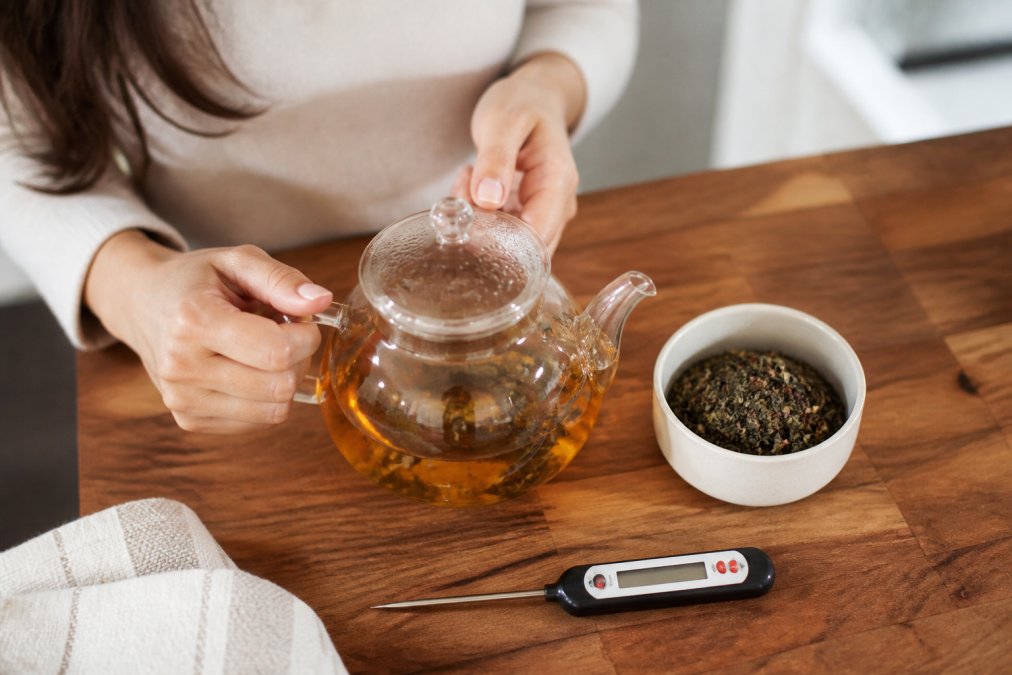
- Heat your water to the right temperature for your tea type. Use the chart above. If you have no thermometer, boil and then rest the kettle for two to three minutes for black and oolong, or four to five minutes for green and white.
- Measure your leaves. One teaspoon per 8 ounces, or 2.5 grams per 12 ounces on a scale. Adjust up for large whole leaves.
- Warm the vessel. Pour a little hot water into your teapot or mug, swirl it, and discard. A cold vessel drops your water temperature the moment you pour, which shortens the effective steep.
- Add the leaves and pour the water over them. Pour so the leaves tumble and circulate rather than sitting in a still pile.
- Start your timer immediately. Green and white: 2-3 minutes. Oolong: 3-4 minutes. Black and chai: 3-5 minutes.
- Taste at the low end of the range. Pull the infuser or pour off the tea when the flavor is where you want it, not when the clock says so.
- Decant fully. Get all the liquid off the leaves so they stop steeping.
- Re-steep if you like. Add fresh hot water to the same leaves and add 15-30 seconds to the time.
Troubleshooting Bitter or Weak Tea
Bitter tea almost always means too much heat, too much time, or too much leaf. Work through them in that order, changing one variable at a time so you know what fixed it.
- Bitter and drying: drop your water temperature by 10°F. This is the single most effective fix for green and white teas.
- Bitter but not strong: you are over-steeping a small amount of leaf. Add more leaf and shorten the time.
- Weak and watery: increase the leaf quantity by about a third. Do not simply steep longer, or you trade weakness for bitterness.
- Weak despite plenty of leaf: your leaves may be packed too tightly in a small infuser and cannot expand. Switch to a larger basket or brew directly in the pot.
- Flat and dull: check your water. Heavily chlorinated or very hard water mutes aroma and produces a chalky finish. Filtered water fixes this more often than people expect.
- Astringent aftertaste: you are squeezing the leaves or pouring off too slowly. Let gravity do the work.
Storing Loose Leaf Tea to Keep It Fresh
Loose leaf tea goes stale, and it does so faster than most people assume. The enemies are air, light, heat, and moisture, plus strong odors from whatever sits nearby in the cupboard.
What works:
- An opaque, airtight container. A tin with a tight lid or a sealed ceramic jar. Clear glass looks good on the shelf and lets light degrade the leaves.
- A cool, dark cabinet. Not above the stove, not on a sunny windowsill, not in the fridge. Fridge storage introduces condensation every time you open the container.
- Small quantities. Buy what you will drink in a few months. A 3oz pouch is a sensible size for a single daily drinker.
- Keep blends separate. A smoky chai and a floral green tea stored in the same container will trade aromas.
Frequently Asked Questions
What are common mistakes when brewing loose leaf tea?
The three most common mistakes are using water that is too hot, steeping too long, and guessing at the tea-to-water ratio. Water at a rolling boil will scorch green and white tea, pulling out tannins that make the cup bitter and astringent. Steeping past the recommended window does the same thing even at the right temperature. And without a scale or measuring spoon, most people use too little leaf, which produces a thin, weak cup they blame on the tea itself.
Can I brew loose leaf tea without a specialized infuser?
Yes. A fine-mesh kitchen sieve, a French press, or a simple two-cup method all work. With the two-cup method, steep the leaves in one cup, then pour through a strainer into a second cup, leaving the leaves behind. You can also brew directly in a mug and skim the floating leaves off the surface with a spoon after steeping. None of these require special equipment, and the flavor is the same.
How long are you supposed to steep loose leaf tea?
Steeping time depends on the tea type. Green and white teas need 2 to 3 minutes at 160 to 180°F. Oolong sits in the middle at 3 to 5 minutes and 185 to 195°F. Black tea, including English Breakfast and Earl Grey, needs 3 to 5 minutes at 195 to 205°F. Herbal blends and masala chai often want 5 to 7 minutes to draw out full flavor. Start at the low end and add 30 seconds on your next cup if you want more body.
How do I store loose leaf tea to maintain freshness?
Keep loose leaf tea in an airtight container away from light, heat, and moisture. A opaque tin or a sealed ceramic jar stored in a cool cupboard works well. Avoid clear glass jars on open shelves, since light degrades the leaves and fades the aroma. Buy in quantities you will finish within a few months rather than stocking up on large bags. If you want to try several varieties without committing to a full bag, sample sizes are a practical way to rotate through options while they are still fresh.